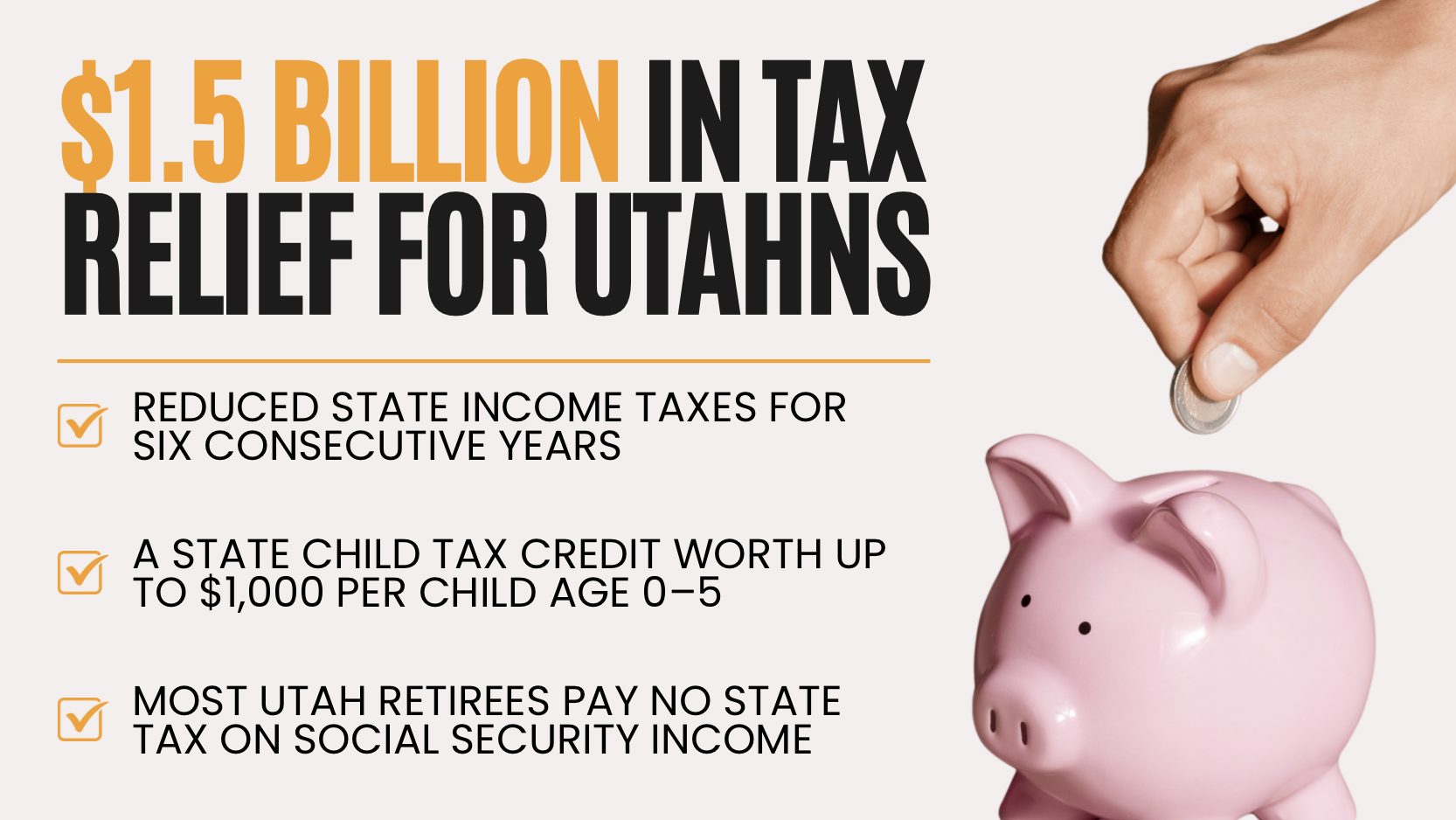
Utah has cut income taxes six years in a row, delivering more than $1.5 billion in cumulative tax relief to individuals, families, retirees, and businesses. The strategy is straightforward: keep taxes low, let the economy grow, and use that growth to fund the services Utahns depend on – without raising rates. It is a cycle that has worked. Utah has ranked first in the nation for economic outlook for 19 consecutive years, leads the country in social mobility, and consistently earns top marks as the best place in America to start and grow a business.
Lower rates have not meant reduced services. They mean a stronger economy generating more resources for investing in education, infrastructure, and public safety.
Utah’s Track Record: What the National Rankings Show
The results speak for themselves.
Utah has ranked first in the nation for best economic outlook for 19 consecutive years via Rich States, Poor States. The Archbridge Institute ranked Utah No. 1 in the nation for social mobility in its 2025 report, meaning Utahns have a better shot at improving their economic circumstances – regardless of where they started – than residents of any other state.
For businesses, the picture is equally strong. WalletHub ranked Utah No. 2 in the nation for best state to start a business in 2026, citing Utah’s ease of securing business loans, its fifth-largest year-over-year employment growth at over 3%, and a tech-savvy workforce. WalletHub also ranked Utah No. 3 for best state economy in 2026, noting that Utah’s median annual household income, adjusted for cost of living, tops $91,600, the highest in the nation.
CNBC ranked Utah the No. 1 cheapest state to start a business in 2025, pointing to low corporate taxes, low utility costs, and the second-highest SBA loan volume per capita in the country. Bankrate ranked Utah No. 2 in the nation for best small business environment in 2024, citing access to capital, cost of doing business, workforce availability, taxes, regulations, and infrastructure.
2026: Lower Income Tax, Gas Tax Holiday, and Expanded Child Tax Credit
The 2026 General Session continued a six consecutive year streak of tax relief, adding to more than $600 million in income tax reductions delivered over the prior two sessions alone.
S.B. 60 — Income Tax Rate Cut to 4.45%
S.B. 60, carried by Rep. Steve Eliason, reduced the state income tax rate from 4.50% to 4.45%, providing $101 million in ongoing annual savings for Utah taxpayers. Over five consecutive sessions, the cumulative reduction amounts to an 11% cut from the starting rate.
H.B. 575 — Gas Tax Reduction
H.B. 575, carried by Rep. Cal Roberts, reduced the state gas tax by 15% — approximately 6 cents per gallon, saving Utah drivers an estimated $40 million. The bill also streamlines permitting for fuel pipelines and includes industry commitments to increase Utah fuel production by 12.5% over five years, pairing immediate price relief with a long-term supply strategy.
H.B. 290 — Expanded Child Tax Credit Income Thresholds
H.B. 290, carried by Rep. Tracy Miller, raised the income thresholds for Utah’s child tax credit so more families qualify. Joint filers can now earn up to $61,000 (up from $54,000), single filers and heads of household up to $49,000 (up from $43,000), and married filing separately up to $30,500 (up from $27,000). The expansion provides an additional $7.1 million in tax relief to qualifying Utah families.
H.B. 190 — Business Child Care Tax Credit
H.B. 190, carried by Rep. Jason Thompson, offers tax credits to businesses that provide child care for employees, reducing total income tax liability for qualified taxpayers by $2.9 million annually.
H.B. 236 — Truth in Taxation Transparency
H.B. 236, carried by Rep. Karen Peterson, strengthened Utah’s Truth in Taxation process by requiring local taxing entities to present a budget showing how they would operate without a proposed tax increase, giving residents earlier and more meaningful input before any local tax hike takes effect.
2025: Income Tax Cut, Social Security Relief, and Childcare Credits
The 2025 session delivered $127 million in tax relief, pushing the cumulative total to nearly $1.5 billion.
H.B. 106 — Income Tax Rate Cut to 4.50%, Expanded Child Credit, and Employer Child Care Credit
H.B. 106, carried by Rep. Kay Christofferson, reduced the state income tax rate from 4.55% to 4.50%, providing $103 million in annual tax relief. The bill also expanded the child tax credit to cover children through age five and created a nonrefundable employer child care tax credit for businesses that build or operate child care facilities for employees.
S.B. 71 — Expanded Social Security Tax Relief
S.B. 71, carried by Rep. Walt Brooks, expanded the Social Security income tax credit for the fourth consecutive time since 2021, raising the income threshold from $75,000 to $90,000 for households filing jointly. Eligible seniors can save up to $4,545 per year on their state income tax. The change amounts to a $24 million tax cut annually.
2024: Lower Income Tax and an Expanded Child Tax Credit
S.B. 69 — Income Tax Rate Cut to 4.55%
S.B. 69, carried by Rep. Kay Christofferson, reduced the state income tax rate from 4.65% to 4.55%, delivering approximately $167 million in tax relief.
H.B. 153 — Child Tax Credit Expanded to Age 4, Plus Home Daycare Expansion
H.B. 153, carried by Rep. Susan Pulsipher, expanded the child tax credit to include children 4 and younger, providing $2.3 million in additional tax relief for families, and expanded home daycare opportunities to increase child care supply.
2023: Largest Single-Year Tax Cut and Utah’s First Child Tax Credit
H.B. 54 — Income Tax Rate Cut to 4.65%
H.B. 54, carried by Rep. Steve Eliason, reduced the state income tax rate from 4.85% to 4.65% as part of a $482 million total tax relief package. It also expanded Social Security tax relief for households earning up to $75,000, increased the state Earned Income Tax Credit from 15% to 20% of the federal credit, and created a double dependent exemption for newborn children.
H.B. 170 — Utah’s First Child Tax Credit
H.B. 170, carried by Rep. Susan Pulsipher, created Utah’s first-ever state child tax credit: a $1,000-per-child, $10 million annual credit for children under age four. This laid the foundation for credit expansions in every subsequent session.
H.B. 301 — Gas Tax Reduction
H.B. 301, carried by Speaker Mike Shultz, delivered a $25 million gas tax reduction, providing relief at the pump for Utah drivers.
H.B. 130 — Adoption Tax Credit
H.B. 130, carried by Rep. Rex Shipp, created a $2.6 million annual adoption tax credit supporting families who grow through adoption.
2022: Income Tax Rate Cut and Utah’s First Earned Income Tax Credit
SB 59 — Income Tax Rate Cut to 4.85%, First EITC, and Social Security Relief
SB 59, carried by Rep. Casey Snider, reduced the state income tax rate from 4.95% to 4.85%, created Utah’s first state Earned Income Tax Credit, and expanded Social Security tax relief for retirees, delivering approximately $193 million in tax relief. The EITC established a new benefit for lower-income working Utahns that has been strengthened in subsequent sessions.
2021: Tax Relief for Retirees, Veterans, and Families
HB 86 — Social Security Tax Credit Expanded
HB 86, carried by Rep. Walt Brooks, expanded the state income tax credit for Social Security recipients, raising the income threshold for retired couples from $32,000 to $50,000. The change directed approximately $18.3 million in ongoing annual relief to nearly 67,000 retirees on fixed incomes.
SB 11 — Military Retirement Tax Exemption
SB 11, carried by Rep. Candice Pierucci in the House, eliminated state income taxes on military retirement pay, providing approximately $23.8 million in ongoing annual tax relief to nearly 18,100 Utah veterans – an average savings of $1,315 per year. Utah had been one of only a few states to fully tax military retirement income, and the change was designed in part to stem the outflow of veteran talent to lower-tax states.
SB 153 — Dependent Exemption Restored
SB 153, carried by Rep. Jeff Moss in the House, restored a significant portion of Utah’s personal dependent exemption that had been eliminated by federal tax law changes in 2017. The bill directed approximately $53 million in ongoing annual relief to more than 388,400 Utah taxpayers – an average savings of $140 per year per household.
What Utah’s Tax Cuts Mean for Families, Retirees, and Businesses
Utah’s tax reduction strategy is designed to reach Utahns at every stage of life. Families with young children benefit from a growing child tax credit expanded in every session since 2023. Retirees on fixed incomes have seen Social Security tax relief expanded every year since 2021. Working Utahns at every income level benefit from a lower flat income tax rate. Businesses that invest in employee child care receive direct tax incentives. And drivers across the state have received targeted relief at the pump.
The Legislature has also been deliberate about building on each year’s work. Each rate cut adds to the effect of every prior cut, and each credit expansion reaches more families than the one before it. The results show up not just in taxpayers’ wallets, but in national rankings that consistently place Utah among the best states in the country for economic opportunity, upward mobility, and business formation.
How Utah’s Tax System Works
Utah’s approach to taxation is a deliberate balance across income, transactions, wealth, and extraction taxes. Rather than imposing high rates on any single segment, the state maintains lower rates across a broad base: individual income tax, corporate income tax, sales tax, property tax, fuel taxes, and severance taxes on oil, gas, and mining.
Utah’s constitution directs all income tax revenue exclusively to education, children’s programs, and services for people with disabilities. Sales tax funds the general fund, with major earmarks for transportation and Medicaid. Property tax is entirely local – no property tax revenue goes to the state general fund. The average primary residential property tax effective rate of 0.52% is one of the lowest in the nation, and 58.8% of all property tax revenue goes to schools. Utah’s rainy day fund balances now exceed its net bond indebtedness, making the state effectively debt free. The state maintains a triple-A bond rating, which reduces borrowing costs and, in turn, reduces how much in taxes needs to be collected to fund public services.
Frequently Asked Questions About Utah’s Tax Cuts
How much has Utah cut taxes in the last six years?
The Utah Legislature has delivered more than $1.5 billion in cumulative tax relief over six years, spanning 2021 through 2026. The cuts span income taxes, the gas tax, child tax credits, Social Security benefits, earned income tax credits, and business tax incentives.
What is Utah's current income tax rate?
Utah’s state income tax rate has been reduced in five consecutive sessions, falling from 4.95% to 4.45% – an 11% reduction from the starting rate. SB 60 in 2026 was the most recent cut, lowering the rate from 4.50% to 4.45% and providing $101 million in ongoing annual savings.
Does Utah tax Social Security income?
Utahns filing jointly with income below $90,000 qualify for a state tax credit that effectively eliminates state income tax on Social Security benefits. Eligible seniors can save up to $4,545 per year.
Who qualifies for Utah's child tax credit?
After H.B. 290 in 2026, the credit is available to joint filers earning up to $61,000, single filers and heads of household earning up to $49,000, and married filing separately earning up to $30,500. Eligible children must be age 5 or younger. The credit is worth up to $1,000 per qualifying child.
How much did Utah cut the gas tax?
H.B. 575 reduced the state gas tax by 15% – about 6 cents per gallon – saving Utah drivers approximately $40 million over the six-month period.
Is Utah actually debt free?
Effectively, yes. Utah’s rainy day fund balances now exceed its net bond indebtedness – a milestone that is largely unreported. The state maintains a triple-A bond rating, which reduces borrowing costs and, in turn, reduces how much in taxes needs to be collected to fund public services.
What is Utah's Truth in Taxation law?
Truth in Taxation is Utah’s mechanism for keeping local tax increases transparent. When a local entity wants to collect more revenue than the prior year, it must hold a public hearing. H.B. 236 added a new 2026 requirement: local entities must show the public a budget reflecting how they would operate without the proposed increase, giving residents earlier and more meaningful input before any local tax hike takes effect.
For more on the Utah House Majority’s 2026 session priorities, visit the House Majority website. To read the official bill text, visit le.utah.gov.