Utah has built one of the nation’s most affordable and efficient electricity systems. The challenge now is preserving that advantage as the state grows, electricity demand rises, and the grid requires continuous investment.
Utah had the lowest average residential electricity price in the nation in 2024 and the third-lowest price across all sectors. The state also uses energy efficiently. Utah’s energy intensity, a measure of how much energy is required to produce a dollar of state GDP, is lower than roughly two-thirds of states in the country, while per-capita electricity consumption is lower than in about three-fourths of them.
That performance is supported by a diverse generation mix. In 2024, approximately 45% of Utah’s electricity came from coal, 32% from natural gas and 22% from renewable sources. Solar has accounted for about 94% of the new generating capacity added in Utah since 2015, while three geothermal facilities in southwestern Utah make the state the nation’s third-largest producer of utility-scale geothermal electricity.
These advantages did not happen by accident, and they won’t sustain themselves automatically. For six straight years, Utah lawmakers have worked to protect existing ratepayers, prepare for growing demand, strengthen the grid, and expand the range of energy resources available to the state.

Utah Electricity Rates: How the Legislature Protected Ratepayers
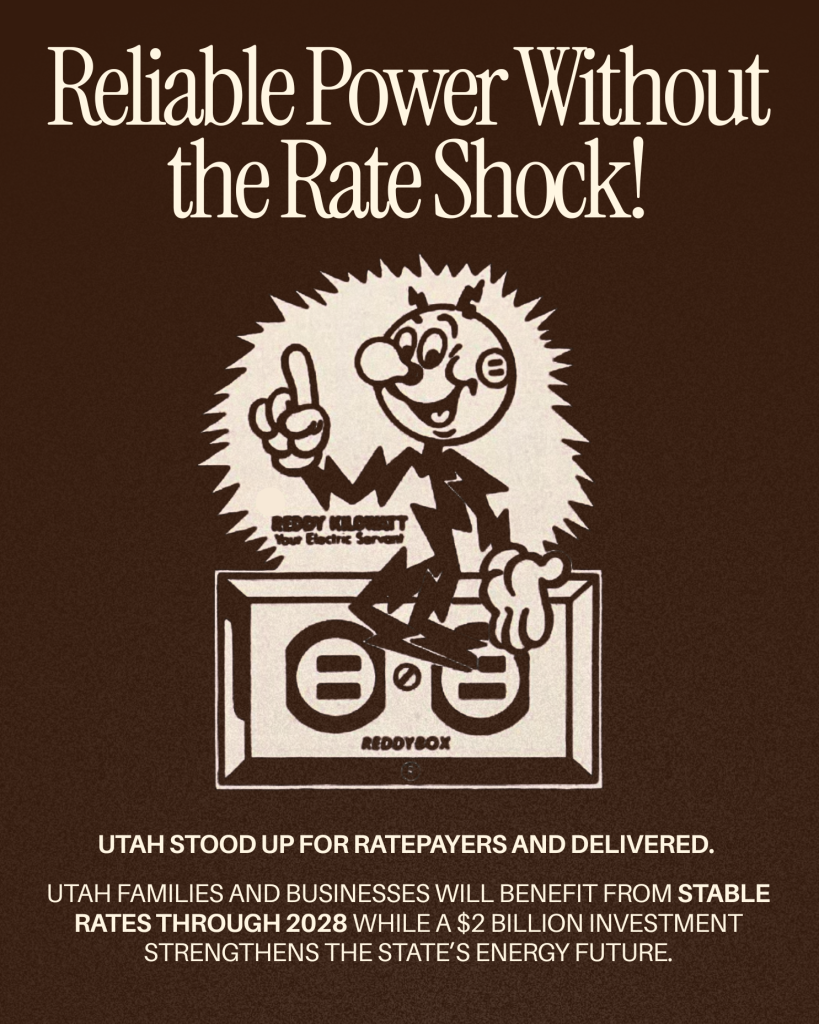
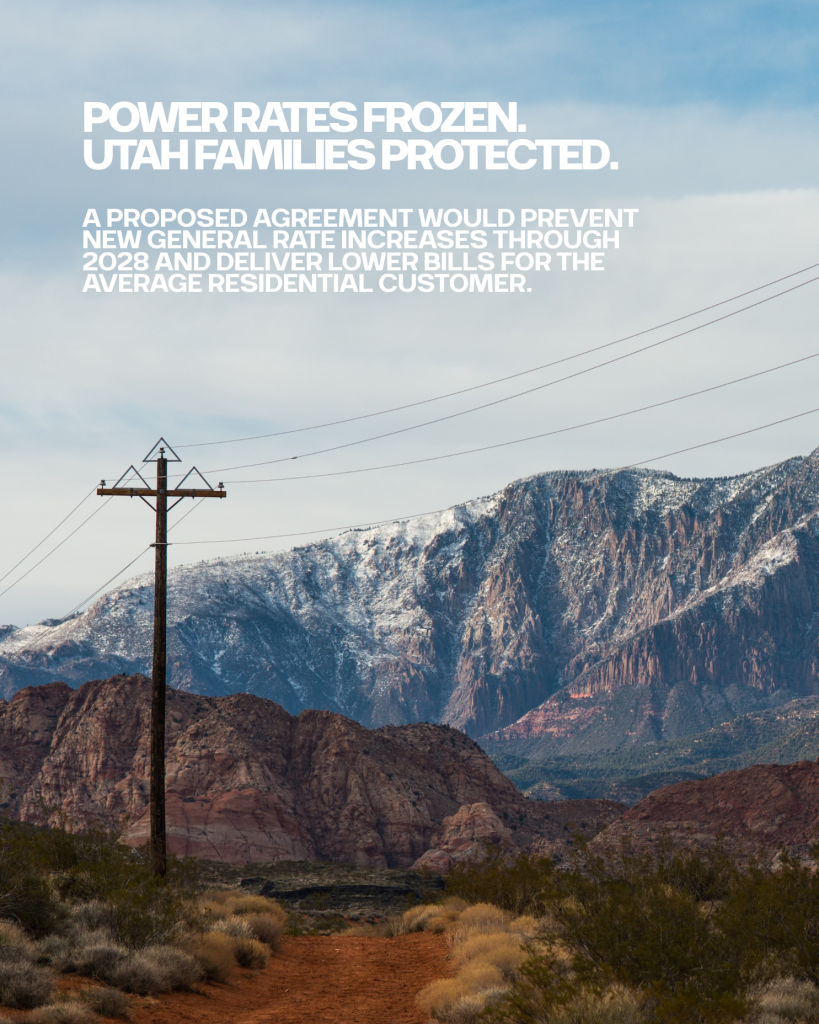
That policy isn’t just theoretical. In 2024, Rocky Mountain Power threatened rate increases as high as 30%, later reduced to 18%, before settling with the Utah Public Service Commission this year. Under the settlement, the average residential customer will see bills drop 6.4% overall, with no new rate hike planned through 2028 – proof that the ratepayer protections lawmakers built are holding. RMP also committed to $2 billion in new Utah infrastructure investment as part of the deal, pairing near-term bill relief with a long-term stake in the state’s grid.
Utah Energy Policy: Keeping Up With Population Growth and Rising Demand
The clearest thread running through recent sessions is an effort to keep the cost of new electricity demand off existing customers’ bills. SB 132 in 2025, carried by Sen. Scott Sandall and Rep. Colin Jack, is the most direct expression of that principle: it allows very large electricity users to source power from a utility or a private generation provider, but requires that residential and business customers not bear the cost of serving those large new loads.
HB 238 from the 2026 session, carried by Rep. Carl Albrecht and Sen. Evan Vickers, reinforces the same guardrail from the regulatory side, keeping the Public Service Commission actively engaged in the regional bodies that manage the electric grid and wholesale power markets – so Utah has a seat at the table in multistate decisions rather than absorbing the outcome after the fact.
Nuclear Energy in Utah: Building the State’s Next Power Source
A second thread has been laying the institutional groundwork for nuclear power well before any reactor gets built. HB 249 from 2025, carried by Rep. Carl Albrecht and Sen. Ann Millner, created the Utah Advanced Nuclear and Energy Institute, a partnership between the state, the Idaho National Laboratory, and public and private institutions of higher education located in the state; the Utah Nuclear Energy Consortium; the Utah Energy Council. The bill also designated energy development zones and established an investment fund to support them.
Passed in 2026, HB 78, carried by the same sponsors as the broader nuclear push, created the Nuclear Energy Regulatory Office to oversee the nuclear fuel cycle and directed the state to pursue expanded “Agreement State” status with federal regulators – letting Utah license certain nuclear activities itself rather than routing everything through Washington. HCR 9 from 2025 extended that ambition regionally, formalizing an energy compact with Idaho and Wyoming to pursue advanced nuclear power together.
Utah’s Long-Term Energy Strategy and Infrastructure Planning
Utah has long had an all of the above approach to energy. Lawmakers have focused less on any single technology and more on building the tools to anticipate demand, guide investment and avoid future energy shortages. HB 426 in 2023 directed the Office of Energy Development to create Utah’s first long-term Strategic Energy Plan. HB 48 in 2024 built on that work by requiring continued long-term planning and strengthening Utah’s voice in federal energy policy.
That same year, HB 374 refocused state energy policy around market-based solutions and required annual reporting on implementation. SB 224 added a financial component by allowing utilities to recover costs associated with reliable, dispatchable generation and creating a wildfire liability fund.
In 2026, HB 514 created the Utah Energy Infrastructure Service District, expanding the Utah Energy Council’s ability to finance the infrastructure this long-term planning is intended to support.
Modernizing Utah’s Electric Grid
A fourth thread focuses on maintaining and modernizing Utah’s physical and regulatory energy infrastructure. HB 389, passed in 2023, required certain electric utilities to prepare power delivery quality plans so the grid could accommodate new generation without reducing service quality for existing customers.
In 2025, HB 70 gave the Utah Energy Council a role in planning for decommissioned energy facilities and preserving those sites for future redevelopment. HB 85 streamlined air permitting for new and expanded facilities.
Several 2024 bills supported that broader effort. HB 191 strengthened the requirements for retiring power plants early. HB 241 replaced “renewable energy” with the broader term “clean energy” in state law, leaving room for technologies such as nuclear power and better aligning Utah policy with federal terminology. HB 317 directed the state to study a fuel storage reserve for transportation, heating and electricity generation, while HB 410 established the Utah San Rafael Energy Lab as a hub for energy research and commercialization.
Why Utah Has Some of the Lowest Electricity Rates in America
For everyday Utahns, six years of this work means electricity that stays among the cheapest in the country even as demand climbs. For industry, particularly data centers and other large power users, it means Utah welcomes growth while ensuring existing customers are not forced to subsidize it.
For Utah’s long-term energy security, it means a true all-of-the-above strategy: maintaining reliable coal and natural gas generation while expanding nuclear, solar and geothermal capacity. New institutions, including the Nuclear Energy Regulatory Office, Utah Energy Council and San Rafael Energy Lab, will help guide that transition.
Frequently Asked Questions About Utah's Energy Policy
Is Utah's electricity actually the cheapest in the nation?
Utah’s average residential electricity price was the lowest in the nation in 2024, and its all-sector average price ranked third-lowest.
Is Utah pursuing nuclear power?
Yes. Since 2025, the Legislature has built a full regulatory and institutional framework for nuclear development, including the Nuclear Energy Consortium, the Nuclear Energy Regulatory Office, and a regional energy compact with Idaho and Wyoming aimed at advanced nuclear cooperation.
How is Utah protecting ratepayers from rising electricity demand?
SB 132 in 2025 and HB 238 in 2026 both require that large new electricity users not pass their costs onto existing residential and business customers, and that regulators stay actively engaged in the regional grid organizations that affect Utah prices.
What happened with Rocky Mountain Power's proposed rate hikes?
RMP threatened increases as high as 30%, later reduced to 18%, before settling with the Public Service Commission in 2026. The settlement produces a 6.4% net decrease in bills for the average residential customer, with no new rate increase planned through 2028, alongside $2 billion in new RMP infrastructure investment in Utah.