No state has done more to protect children online than Utah.
Our yearslong fight to hold social media companies accountable has helped deliver a landmark $12.2 billion settlement with Meta, including an expected $212 million for Utah and sweeping reforms to protect young users.
The agreement includes stronger age verification, limits on screen time, greater parental controls, protections against addictive algorithms and independent oversight. Since 2023, the Legislature has passed eight bills targeting social media addiction, age verification, predatory algorithms, app store accountability and online adult content.
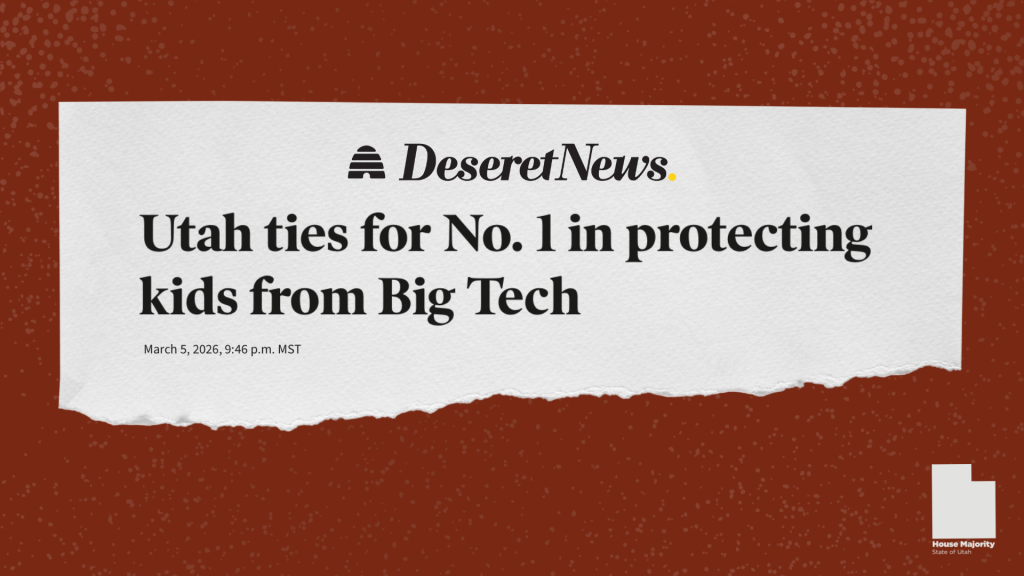
That work helped earn Utah the No. 1 ranking in the nation for protecting children online, according to the Childhood Index.
Social Media and Teen Mental Health: What the Data Shows
The data on social media and children’s mental health is stark. Adolescents who spend more than three hours per day on social media face heightened risk for mental health problems, and surveys of 8th and 10th graders find the average teen spends 3.5 hours daily on these platforms, with nearly one in seven spending more than seven hours a day.
Almost 60 percent of teenage girls report being contacted by strangers on social media in ways that made them feel uncomfortable. And research consistently links compulsive social media use to depression, anxiety and stress, particularly among young people.
Former U.S. Surgeon General Dr. Vivek Murthy described the stakes plainly: “The mental health crisis among young people is an emergency – and social media has emerged as an important contributor.”
Utah’s Legislature didn’t wait for Washington to protect our kids.
Lawmakers took action in 2023, establishing some of the nation’s first comprehensive protections for children online and helping lay the groundwork for the reforms now reflected in the landmark Meta settlement.
How Utah Led the Fight for Child Online Safety
2023: Utah Becomes First State to Regulate Social Media for Minors
Utah became the first state in the country to begin restricting how minors use social media accounts, passing two landmark bills in the same session.
HB 311, carried by Rep. Jordan Teuscher, enacted the Utah Social Media Regulation Act, making social media companies liable for harm caused to minors by addictive design features. Critically, it established a rebuttable presumption, shifting the burden of proof to the companies, not the families they harmed.
SB 152, carried in the House by Rep. Jordan Teuscher, required social media companies to verify user ages in Utah, obtain parental consent for minors, give parents access to their children’s accounts, ban targeted advertising to minors, and limit access hours.
SB 287, carried in the House by Rep. Susan Pulsipher, required websites that distribute pornography or other content harmful to minors to verify the age of their users before granting access.
2024: Stronger Utah Social Media Protections for Kids
After reviewing the 2023 legislation and consulting with experts, the Legislature enhanced HB 311 and SB 152 with stronger, more targeted laws designed to withstand legal scrutiny while expanding protections.
HB 464, carried by Rep. Jordan Teuscher, focused accountability on what the evidence shows causes the most harm: algorithms and engagement-driven design. The bill established a private right of action allowing parents to hold social media companies liable specifically for algorithmic harm to their children. It also required platforms to limit minors to three hours of daily use, restrict access between 10:30 p.m. and 6:30 a.m., obtain parental consent, and remove engagement-driving design features – autoplay, infinite scroll, push notifications – from minor accounts.
SB 194, carried in the House by Rep. Jordan Teuscher, created an age assurance process for social media platforms and established default privacy settings for minor accounts: including disabled search indexing, direct message restrictions visible only to connected accounts, and encryption of minors’ personal data.
Parents received supervisory tools: the ability to set time limits, schedule mandatory breaks, view total usage, and see their child’s connected accounts. Social media companies were prohibited from collecting and selling data on minors without verifiable parental consent.
Legal challenges are an expected part of pioneering legislation. Both HB 464 and SB 194 are currently stayed pending a decision by the U.S. Court of Appeals for the 10th Circuit.
2025: App Store Accountability Act – Age Verification at Download
SB 142, the App Store Accountability Act, carried in the House by Rep. James Dunnigan, extended Utah’s protections to the point of download. App store providers, including the major platforms operated by the world’s largest tech companies, must now verify user age categories and, for minors, require a parent account affiliation. Parents must approve app downloads and purchases. App developers must age-rate their products, and parents must be notified when significant changes alter an app’s content.
The law recognized that protecting children on a platform is incomplete if nothing governs what gets onto their devices in the first place.
2026: Targeted Advertising Tax and Online Adult Content Protections
The 2026 session added two significant pieces to Utah’s framework.
SB 287, carried in the House by Rep. Jordan Teuscher, imposes a 4.7% tax on the Utah-based profits of companies that deliver targeted advertising to Utahns with revenue going directly into a Targeted Advertising Restricted Account. Funds support child literacy, youth mental health programs, civic education, youth sports and recreation, youth volunteerism, adoption and foster care, and public awareness campaigns about the effects of targeted advertising. The tax applies to entities making at least $1 million in targeted advertising revenue in Utah, or $100 million or more in total revenue.
SB 73, carried in the House by Rep. Steve Eliason, further strengthens Utah’s age verification requirements for adult content platforms. The bill imposes a 2 percent excise tax on revenues from online adult content, with proceeds funding mental health programs and enforcement of age verification requirements. It also prohibits platforms from encouraging users – particularly minors – to use VPNs to bypass age gates, and requires that any age verification methods used meet standards established by the Division of Consumer Protection.
What Utah's Social Media Laws Mean for Parents and Families
Utah parents now have more legal tools, more platform accountability, and more supervisory power over their children’s digital lives than parents in almost any other state. Social media companies that design their products to addict children face real liability in Utah courts. App stores can’t hand a minor unrestricted access to any app without parental approval. Platforms that distribute adult content face financial accountability if they fail to verify ages.
Families aren’t on their own. The Legislature has consistently ensured that the burden of protecting children falls on the companies with the power, and the profit motive, to design safer products.
How Utah Leads the Nation on Child Online Safety
Several features of Utah’s framework stand out nationally.
Utah consistently uses private rights of action, allowing families to sue companies directly, rather than depending on government enforcement alone. This shifts accountability to where it belongs: on the companies that profit from minors’ engagement.
Utah’s laws use rebuttable presumptions. If a company’s platform harms a minor, the company bears the burden of proving its design wasn’t at fault, not the family.
And Utah has moved session after session, building on each year’s work rather than treating online safety as a single-session issue. The result is layered, interlocking protection that covers social media design, age verification, app distribution, data privacy, adult content, and advertising revenue – across multiple platforms and multiple points of access.
Frequently Asked Questions About Utah's Child Online Safety Laws
What protections does Utah law give parents over their children’s social media use?
Under Utah law, social media platforms must obtain parental consent before a minor can create an account, give parents access to supervisory tools including time limits and usage data, restrict minor accounts from certain privacy-invasive features by default, and obtain verifiable parental consent before collecting or selling a child’s data. Parents can also pursue legal action against companies whose algorithmic design causes harm to their children.
Can Utah families sue social media companies for harm to their children?
Yes. Utah’s private right of action allows parents to hold social media companies directly liable for harm caused by engagement-driven design – algorithms engineered to maximize time on the platform. The law includes a rebuttable presumption: if a minor is harmed, the company must demonstrate its design wasn’t at fault. Families don’t have to wait for government enforcement.
What is the App Store Accountability Act?
The App Store Accountability Act, SB 142 from 2025, requires major app store providers to verify user ages and link minor accounts to a parent account. Parents must approve any app download or purchase made by a minor. App developers must age-rate their products, and parents must be notified when significant changes alter an app’s content – ensuring that parental consent isn’t a one-time checkbox.
What did Utah do about safeguarding minors from online pornography?
Utah has required age verification for adult content platforms since 2023 via SB 287. The 2026 session strengthened those requirements through SB 73, which added a 2 percent excise tax on adult content revenues to fund enforcement and mental health programs, required verification methods to meet state standards, and prohibited platforms from directing minors to use VPNs to bypass age gates.
How does the targeted advertising tax work?
SB 287 from the 2026 General Session imposes a 4.7 percent tax on the Utah-based targeted advertising profits of companies earning at least $1 million from such advertising in Utah or $100 million or more in total revenue. Revenue goes into a restricted account used exclusively for child and youth programs – including mental health services, literacy, sports, civic education, and public awareness campaigns about the harms of targeted advertising.
The Utah House Majority committed before session to protecting children in the digital age. The legislation passed since 2023, and the years of sustained work that made each new law possible, delivered on that commitment. Utah will continue leading the nation on this issue, building accountability into every layer of the digital economy that profits from children’s attention.
Have Utah's social media laws been challenged in court?
Yes. Legal challenges are an expected part of pioneering legislation. Utah’s 2024 laws, HB 464 and SB 194, have been challenged in federal court and are currently stayed pending a decision by the U.S. Court of Appeals for the 10th Circuit. Utah’s App Store Accountability Act, SB 142 from 2025, was also sued but the complaint was withdrawn after the Attorney General’s office clarified that the law authorizes only private rights of action, not government enforcement. Most recently, SB 73 from the 2026 General Session has been challenged with that litigation ongoing.
For more on the Utah House Majority’s 2026 session priorities, visit the House Majority website. To read the official bill text, visit le.utah.gov.
To request a transcript of the House Rules podcast episode, contact utahreps@gmail.com.